Why I'm Still Rolling My IT Band (And You Should Too)

Let me tell you about the time I stopped doing something that was working for my body because the fickle fitness world told me I was wrong.
I'd been foam rolling my outer thighs—my IT band, lateral quads, all that lateral line tissue—for years. It felt good. It helped. When I did it consistently, I stood straighter, my glutes worked better, and honestly, everything just felt more aligned.

Then came the backlash.
"Don't roll the IT band—it's fascia, not muscle!"
"You can't stretch it anyway, so what's the point?"
"Complete waste of time!"
And suddenly, everyone stopped. Including me, for a while.
But here's what I've learned after years of working with bodies (including my own): You absolutely should roll your outer thighs. Especially if you want your glutes to actually work, your hips to move properly, and your body to stop compensating its way through basic movements.
Let me explain why the anti-IT band crowd got it wrong.
The Power Of Your Lateral Fascial Line
Your outer thigh isn't just the IT band. It's your entire lateral line—this fascial highway that runs from your lower leg all the way up to your ribs.
We're talking about your fibularis muscles down by your ankle, your IT band and TFL (tensor fasciae latae), your glute max and medius, and even your obliques. It's all connected.
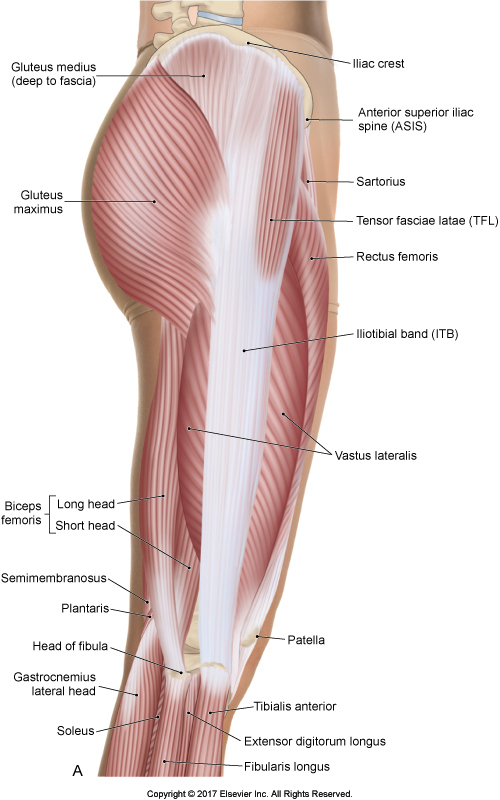
This isn't just structural tissue holding you together. It's sensory. It's neurological. It adapts when other parts of your body stop doing their job properly.
And when your glutes go offline (which they do for most of us who sit all day), guess what picks up the slack?
Your lateral line.
It starts doing work it was never meant to do.
The Backlash Was Oversimplified
Yes, the IT band is dense fascia. No, you can't stretch it like a rubber band. The research is clear on that.
But here's what the "don't roll your IT band" people missed: foam rolling was never about stretching it in the first place.
When you foam roll your outer thigh, you're:
Changing the tone of the surrounding muscles
Improving how fluid moves through the tissue
Stimulating pressure sensors that talk to your brain
Releasing overactive muscles that are compensating for lazy glutes
You're not trying to make the IT band longer. You're tuning the entire system that IT band is part of.
Think of it like adjusting the settings on your car stereo. You're not changing the radio waves themselves—you're changing how clearly you can hear the station you want.
Why Your Glutes Need This
If your glutes feel disconnected, weak, or hard to activate, your outer thigh might be hijacking the signal.
When your TFL and the muscles along your IT band are tight and overactive, they start stealing work from your glutes. They compensate. They take over movements your glutes should be handling.
This creates a vicious cycle: your glutes get weaker because they're not being used, and your outer thigh muscles get tighter because they're overworked.
Foam rolling helps break this cycle. It calms down the overactive compensation muscles and gives your glutes space to remember how to do their job.
There's actually a neurological principle behind this called reciprocal inhibition. When you relax one muscle group, its opposite can activate more easily. Release the outer thigh tension, and your glutes can fire more cleanly.
The Changes You Might Notice
I've seen people foam roll their outer thighs and immediately notice they can stand with their feet closer together. Or sit without their knees splaying outward. Or actually feel their glutes working during squats.
These aren't placebo effects. This is your nervous system recalibrating in real time.
When chronic tension in your lateral line is released, your brain can map your hips differently. Your pelvis can find a more neutral position. Your movement patterns can shift.
Setting the Record Straight
Let's be clear about what's true and what's myth:
True: You can't stretch the IT band like a muscle. Also true: That doesn't make foam rolling it useless.
True: The IT band is tough, dense fascia. Also true: The goal isn't to change the fascia itself, but how the whole system around it behaves.
True: Some people foam roll incorrectly and aggressively. Also true: When done thoughtfully, it's therapeutic, not harmful.
If you've been avoiding your outer thighs because someone told you it was pointless, I'd encourage you to reconsider. Especially if your glutes feel disconnected or your hips feel locked up.
Your body might be asking for exactly the kind of release you've been avoiding.
Start gently. Breathe while you do it. Pay attention to what shifts.
You might be surprised by what changes when you give your lateral line permission to let go.
Coming up in Part 2: Why releasing your outer thighs unlocks more than just muscle tension—and what emotional patterns might be stored there.


Comments