Wormwood Parasite Cleanses: What TikTok Gets Wrong (and What the Evidence Says)

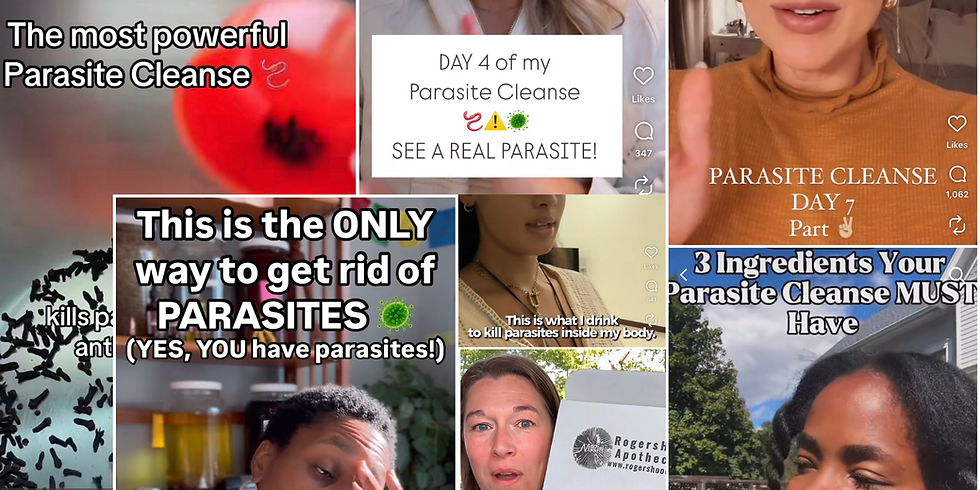
Parasites are real. So is fear marketing. Here’s how to tell the difference.
If you’ve spent any time on wellness TikTok (or Instagram) lately, you’ve seen the script:
“Everyone has parasites.”
“These symptoms mean you’re infected.”
“If you feel worse, that’s die-off.”
“Wormwood will fix it.”
It’s persuasive because it’s simple. It gives you a villain, a checklist, and a protocol you can buy tonight.
It’s also usually not how parasite medicine works.
This isn’t a takedown. Most people are doing their best with the information in front of them. I was, too.
And to be clear: this isn’t me saying parasites aren’t real. They are. So are fungal infections. People do get sick. People do need treatment sometimes. The problem is what happens when a real thing gets turned into a content machine and a product pipeline.
Where holistic parasite talk gets it right
Let’s start with the parts that are true:
Parasites exist and can cause real disease.
So can protozoa, and so can a handful of organisms that genuinely mess with digestion, energy, and absorption.
Fungal infections are real, too.
Athlete’s foot, yeast infections, nail fungus—very real, very common.
You can’t “sterilize” your body.
You live in an ecosystem. The goal isn’t to nuke everything inside you and call it “health.” The goal is function.
Lifestyle matters.
Sleep, nutrition, stress load, hydration, and overall immune resilience affect how you handle exposures. That part of holistic health is real and useful.
So what’s the issue?
The issue is the leap from “parasites can happen” to “parasites explain everything,” with a shopping list attached.
Where it starts to go off the rails
1) The symptom checklist that diagnoses everyone
A lot of parasite content uses symptom lists so broad they could describe nearly any adult living in 2026:
fatigue
brain fog
cravings
mood swings
insomnia
skin issues
bloating
constipation/diarrhea
“feeling off”
Those symptoms can also show up with IBS, stress, under-eating, iron deficiency, thyroid issues, perimenopause, anxiety, depression, medication side effects… the list goes on.
When the “screening” tool catches everyone, it’s not a screening tool. It’s a funnel.
2) The “die-off” logic that can’t lose
This is one of the biggest red flags in cleanse culture: every outcome becomes proof.
Feel nothing? “It’s gentle but working.”
Feel awful? “That’s die-off.”
The promise is basically: “You might feel like trash for a while—tired, nauseous, restless, bloated, breakouts, emotional spirals—but don’t worry, that means it’s working.”
Sometimes people do feel rough during certain kinds of treatment. But in the cleanse world, “die-off” gets used like a universal explanation, which conveniently prevents the obvious next question:
What if this isn’t die-off? What if this is harm? Or intolerance? Or the wrong target?
3) Turning infection into morality
Sometimes the messaging gets weirdly spiritual or moral. Parasites become proof you’re “out of alignment,” “low vibration,” “unconscious,” “not clean,” “not disciplined.”
No.
People get infections from exposures. Travel. Water. Food. Close contact. Childcare. Animals. Bad luck.
This isn’t a character flaw.
4) Herbs marketed like prescription meds
Wormwood blends. Black walnut. Clove stacks. “Broad-spectrum parasite formulas.”
Here’s the honest truth: herbs can be powerful. That’s not an insult to herbs—that’s the point.
But “powerful” cuts both ways. If something has pharmacologic activity, it also has the capacity to cause side effects, interactions, and stress on the body—especially when products vary wildly in concentration and quality.
“Natural” doesn’t automatically mean gentle. It means unregulated.
Wormwood: what it is, what it isn’t
Wormwood is having a moment, so let’s talk about what people think they’re buying vs. what we actually know.
There are different Artemisia species. And yes—there’s a legitimate, evidence-backed malaria drug derived from Artemisia annua (sweet wormwood). But that’s not “a tincture from the internet.” That’s a standardized pharmaceutical pathway used in specific dosing combinations.
When people say “wormwood kills parasites,” they’re usually taking that real fact and stretching it into a universal claim.
What we do not have is strong evidence that over-the-counter wormwood blends reliably clear common human parasites across real-world humans in a predictable way.
And we definitely do not have evidence that “feeling worse” is proof it’s working.
Why vague parasite content isn’t harmless
Because it changes behavior in predictable, costly ways.
People delay evaluation for serious conditions
If you’ve got red flags (blood in stool, significant weight loss, persistent diarrhea, fever, severe pain), the correct move is medical evaluation — not a trip to Vitamin Shoppe.
I’m not saying that to scare you. I’m saying it because some symptoms are not “wait it out.” Some symptoms are not “detox.” Some symptoms require a real workup.
Kids and vulnerable adults get pulled into harsh protocols
A cleanse stack plus restrictive eating plus “binders” plus laxative-style herbs isn’t a casual little wellness experiment—especially for children, pregnant people, or anyone with an eating disorder history.
Every reaction becomes “proof”
This is what keeps people stuck. If the protocol can’t lose, you can’t win. You can only stay in it longer.
The focus shifts from diagnosis to demon-hunting
Instead of asking: “What do I actually have?” people get trained to ask: “What do I need to kill next?”
And that’s not health. That’s paranoia with a supplement cabinet.
A more grounded, holistic approach to parasite cleanses
If you’re worried about parasites, here’s the framework I use:
1) Start with the story
What are your symptoms specifically?When did they start?What happened right before?Any travel, untreated water, undercooked food, exposure to a known case?
2) Ask whether testing makes sense
Not vibes. Not a checklist. Not “everyone has parasites.”If there’s a real reason to suspect infection, testing should be part of the conversation.
3) Keep the medical lane medical
If suspicion is real, I refer out. Testing, diagnosis, and antimicrobial treatment belong with a licensed medical team. I’ll support you through that process and collaborate when appropriate.
4) Use herbs as support, not as a shadow-pharmacy
There’s room for herbs to support digestion, motility, symptoms, appetite, and resilience.
But using long unstandardized stacks as a substitute for diagnosis is not holistic. It’s under-resourced medicine wearing a pretty outfit.
5) Rebuild the baseline
Because the truth is: a lot of people chasing parasites are actually chasing unstable energy, unstable digestion, unstable routines, unstable intake, and a nervous system that’s been running hot for a long time.
And that’s fixable—without making you terrified of your own body.
The bottom line
Parasites are real. But so is fear marketing. So is checklist content that diagnoses everyone. So is a business model that convinces you your body is a contaminated problem to solve forever.
I’m not here to sell you fear. I’m here to help you get your footing back.
If parasite content has you spiraling, your next right step is specificity—not another protocol. If you want support getting your baseline stable (food rhythm, energy, digestion, training that doesn’t wreck you) while we keep the medical lane medical, start with Run Your Plate™.


Comments